Best 4x6 Direct Thermal Labels for 2026
A 4x6 label looks simple on a roll. In practice, it must feed cleanly, print sharply, and stay readable from the packing bench to the customer’s doorstep. Best 4x6 Direct Thermal Labels for 2026 compares the details that matter: adhesive grip, coating quality, printer compatibility, and resistance to heat, sunlight, and handling. Small flaws show up quickly. A curled corner or faint barcode can slow a busy shipping line.
Industry context helps, but it needs careful reading. Smithers’ The Future of Label Printing to 2028 tracks changes across label-printing technologies, while Grand View Research’s Barcode Label Market report examines demand and market segments. Neither report isolates every 4x6 direct thermal use case. Their findings are useful background, not a substitute for testing a label on your own printer and packaging. Market estimates also vary with each report’s definitions.
Mike Fairley, a leading label-industry educator and founder of Label Academy, has emphasized matching label materials and printing processes to the application. In paraphrase, his practical advice is to choose a label for the journey it must survive. That means checking a real roll, not just a product photo: print a barcode, rub it, and leave a sample near a warm packing area. Direct thermal labels need no ribbon, but heat and light can shorten image life. This guide weighs convenience against that limitation. One point deserves more attention than many buying lists give it: the cheapest roll may not be the lowest-cost choice if reprints interrupt fulfillment.
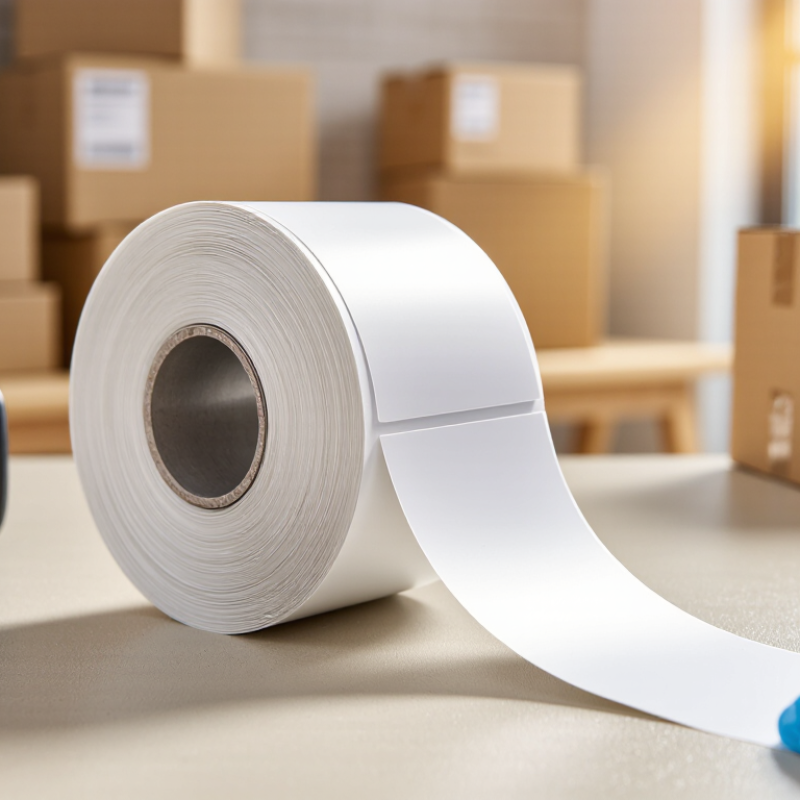
Define 4 × 6-Inch Labels: 101.6 × 152.4 mm for Shipping
A 4 × 6-inch shipping label measures 101.6 × 152.4 mm. The first number is its short edge; the second is its long edge. In a printer, that distinction can feel less obvious. Roll direction and software settings may rotate the layout, but they do not change the label’s physical size. Check the printer’s supported width and label path before ordering.
This format gives room for an address, tracking barcode, and routing details without crowding every line. Leave clear space around barcodes and keep text away from cut edges. Small details matter. A label scaled to “fit” can shrink the print or shift elements. Use actual-size output when available, then inspect a test label beside a ruler. It’s a mundane check, but it can catch clipping.
Direct thermal stock forms images through heat, usually without an ink ribbon. However, coatings and adhesives vary. Sunlight, friction, or warm storage may cause prints to fade or darken sooner. A 4 × 6 label is a standard size, not a guarantee of equal print quality. Match the roll core, outside diameter, and sensing method to the printer. A small test batch is worthwhile; specifications cannot reveal every feeding issue.
Match Label Stock to Common 203- and 300-dpi Thermal Printers
A 4x6 direct thermal label can fit both 203-dpi and 300-dpi printers, but the printer’s resolution is only part of the match. Check the roll width, core size, maximum roll diameter, and sensing method before ordering. A printer that uses a gap sensor needs labels with clear spaces between them. A black-mark sensor needs the marks in the correct position. Small mismatches can cause drifting prints or repeated feed errors.
At 203 dpi, each dot is larger, so bold text and simple barcodes tend to print cleanly. At 300 dpi, finer text and denser graphics have more room for detail. Choose a smooth, even coating to help keep edges sharp, especially on small shipping codes. Still, extra resolution cannot rescue a poorly designed label. Test the actual barcode with a scanner.
Direct thermal stock darkens with heat, so print darkness and speed affect the result. For labels exposed to sunlight, warm vehicles, or frequent handling, test whether the image stays readable over the needed period. Keep a sample near the printer. It is easy to assume every 4x6 roll behaves alike; that assumption can be wrong. Run several labels, check alignment, and scan them before committing to a large order.
Check Roll Core, Adhesive, and Label Count for Printer Compatibility
Shipping volume makes small feed errors costly. The 2024 Parcel Shipping Index estimated 185 billion parcels worldwide in 2023, underscoring the need for labels that print and scan cleanly. For 4x6 direct thermal stock, check the printer manual for roll width, maximum diameter, and core size. A 1-inch core and a 3-inch core are not interchangeable, even when labels look identical. Confirm whether your printer accepts a loose roll or requires a spindle. Tiny mismatch. Real cost.
Match adhesive to the package surface and shipping conditions. Corrugated cartons, recycled mailers, and cold plastic pouches can behave differently. Adhesive may lift from dusty kraft board, while a stronger option can leave residue on reusable totes. Test labels after cartons sit overnight, not only at room temperature. Compare label count with roll diameter, since a high-count roll may exceed the printer’s capacity. GS1’s General Specifications describe barcode sizing and quiet zones; keep the printed area flat and avoid trimming close to the bars. A small trial roll is worth the awkward extra step. Paper specifications do not capture every handling quirk.
Compare Barcode Print Quality Using ISO/IEC 15416’s 0–4 Grade Scale
Best 4x6 Direct Thermal Labels for 2026
Compare Barcode Print Quality Using ISO/IEC 15416’s 0–4 Grade Scale
A barcode can look sharp and still scan poorly. On a 4x6-inch direct thermal label, tiny gaps in a vertical bar or a faint edge can affect verification. ISO/IEC 15416 rates linear barcode print quality on a 0–4 scale. The grade reflects scan-profile results, including symbol contrast, defects, and decodability. Small details matter.
The familiar letter bands make results easier to read: 3.5–4.0 is A, 2.5–3.4 is B, 1.5–2.4 is C, 0.5–1.4 is D, and 0–0.4 is F. GS1’s General Specifications tie acceptable barcode quality to the application, so one score is not a universal pass mark. Check the requirement for your scanning environment. A warehouse tunnel and a handheld scanner may not behave alike.
Test labels with a calibrated verifier, not a phone camera. Review the overall grade and individual scan-profile results; a strong average can hide weak spots. Print several labels at normal speed, then verify them after handling. Watch for heat streaks, pale bars, and smudges near the barcode. Real prints vary. That’s worth remembering. When grades dip, adjust darkness or print speed, then test again before changing the label stock.
Best 4×6 Direct Thermal Labels for 2026 — Compare Barcode Print Quality Using ISO/IEC 15416’s 0–4 Grade Scale
ISO/IEC 15416 grades linear barcode print quality on a scale from 0 to 4, with 4 representing the highest grade. This chart shows the grading scale—not test results for specific labels. Compare 4×6 direct thermal labels using a barcode verifier under consistent print and scanning conditions.
Rank 2026 Picks by Cost per Label, Durability, and Readability
A 4x6 direct thermal label can look inexpensive until roll yield, shipping, and misprints are included. Compare cost per usable label, not just the price per roll. Divide the total roll cost by its stated label count, then account for labels lost to jams or faint printing. A few cents matter when daily batches grow. Small math, big difference.
Durability depends on the route. For indoor parcels moving quickly, standard thermal stock may stay readable through sorting and delivery. Labels exposed to sunlight, heat, moisture, or heavy rubbing can fade or scuff sooner. Test a sample on a typical package: press the corners, handle it, and leave one near a bright window. It is not a laboratory test, but it can reveal obvious weaknesses. Results vary.
Readability is about more than dark print. A sharp barcode needs clean edges, enough contrast, and room around it. Print several labels at the speed and darkness settings you actually use, then scan them under ordinary warehouse lighting. Check small text and barcode lines, especially after the printer warms up. A label that scans once is not necessarily reliable all day. I would also track misprints for a week; that step is easy to skip, and my first estimate would probably be too optimistic.
Best 4×6 Direct Thermal Labels for 2026 — Ranked by Cost per Label, Durability, and Readability
Representative comparison of common 4×6 direct thermal label constructions. Costs are illustrative estimates in USD, calculated from the example pack price and quantity shown; actual prices vary by seller, order size, and shipping. Durability and readability ratings describe typical material performance, not results from a controlled laboratory test.
| Rank | Label type | Example pack | Example price | Cost per label | Durability | Readability | Best suited for |
| 1 | Standard uncoated paper | 1 roll × 1,000 labels | $14.00 | $0.014 | 2/5 — vulnerable to moisture, abrasion, heat, and prolonged light exposure | 4/5 — typically clear when printed at a suitable darkness setting | High-volume shipping and short-term indoor use |
| 2 | Standard paper, smaller roll pack | 1 roll × 500 labels | $9.00 | $0.018 | 2/5 — similar paper-label limitations; keep dry and away from direct sunlight | 4/5 — suitable for typical shipping barcodes and text | Lower-volume shipping or testing printer compatibility |
| 3 | Top-coated paper | 1 roll × 500 labels | $12.00 | $0.024 | 3/5 — coating can improve resistance to smudging and light moisture; not waterproof | 5/5 — coated surface often supports crisp, high-contrast print | Labels needing more handling or dependable barcode contrast |
| 4 | Freezer-grade paper adhesive | 1 roll × 500 labels | $15.00 | $0.030 | 3/5 — low-temperature adhesive is designed for cold application or storage; face stock remains paper | 4/5 — generally clear when dry and printed correctly | Cold storage; confirm the specified application and service temperature range |
| 5 | Synthetic film (such as polypropylene) | 1 roll × 250 labels | $13.00 | $0.052 | 5/5 — film face stock is generally more resistant to tearing and moisture than paper | 4/5 — can print clearly, but results depend on printer settings and material compatibility | Damp or rougher handling; verify the label is designed for direct thermal printing |
Calculation: example pack price ÷ labels per pack. Ratings use a 1–5 scale, with 5 indicating stronger typical performance. Direct thermal labels require no ribbon, but the printed image can fade with heat, sunlight, or abrasion. Before ordering, check label dimensions, roll/core size, adhesive requirements, and compatibility with the specific printer.
